
Research
My research investigates how humans learn about themselves and their environment, make decisions in social settings, and how these processes are altered in psychiatric conditions.
To study these processes, I combine behavioural experiments, computational modelling, and neuroimaging. I am also interested in methods development, especially modelling approaches that extract richer information from behavioural and neural data. This includes reinforcement learning and Bayesian models as well as approaches for analysing neuroimaging data.
Active disambiguation guides inferring controllability and cause in social interactions
Spiering et al., Nature Communications, 2025
Here, we examine how people actively change their behaviour in social interactions to work out how much control they have and what caused a shared outcome. Using a novel social learning task, computational modelling, and fMRI, we found that people strategically seek information that helps them distinguish their own contribution from someone else's.
This is work I did during my PhD at Oxford. I also gave a talk about this work at the Cortex Club (Oxford), available on YouTube.
Paper · Code & data · Preprint
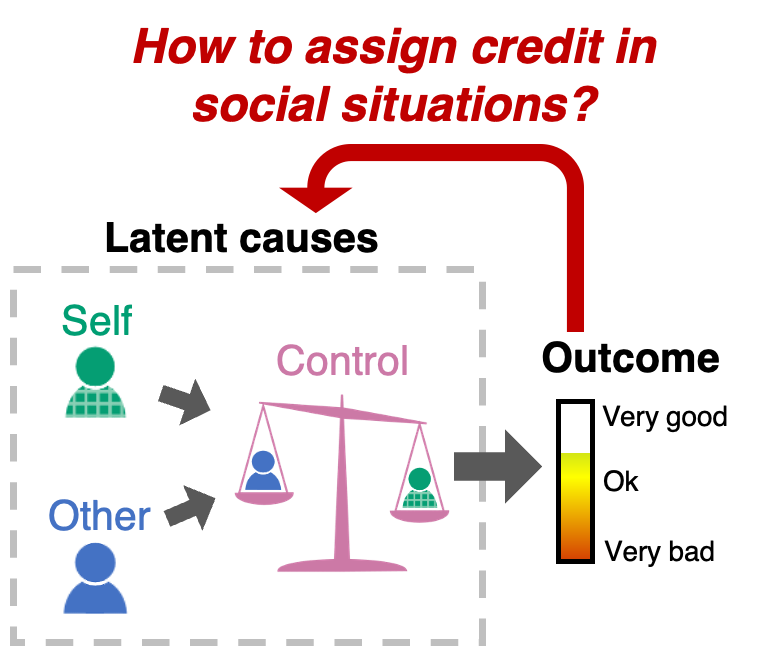
Read a longer summary
When outcomes depend on more than one person, it can be difficult to tell who caused what and how much control each individual had. In this study, we developed a new social learning task to examine how people resolve this ambiguity and infer their own influence over joint outcomes.
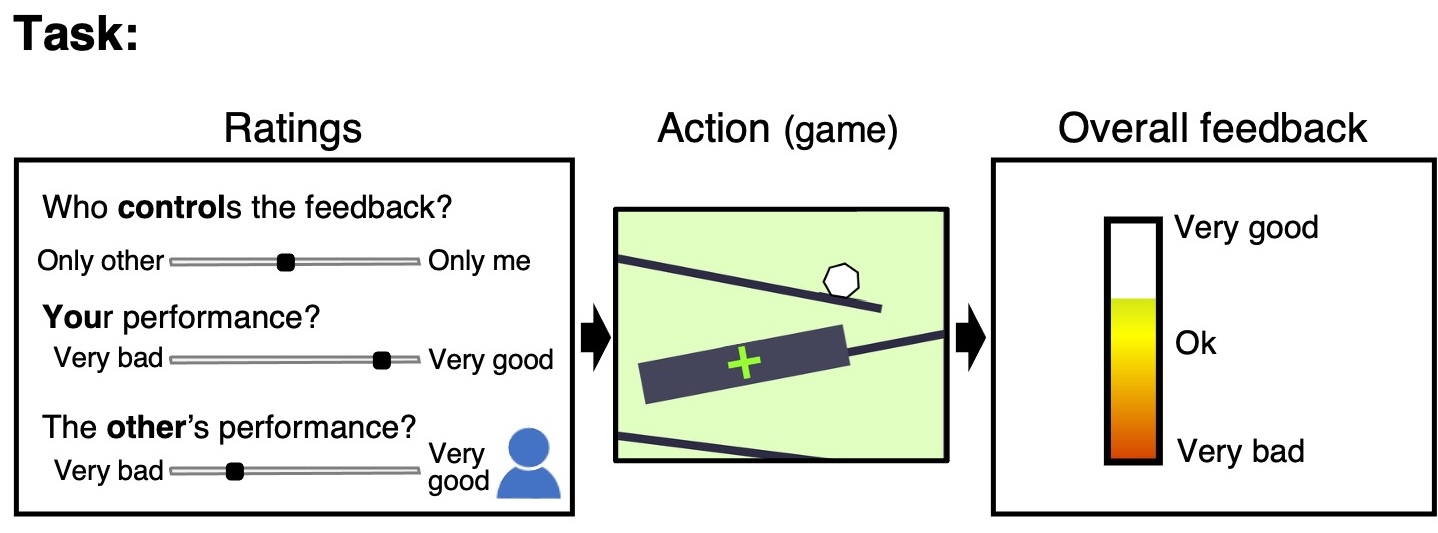
We observed a striking behaviour: People purposefully made mistakes to gather information about their control over ambiguous joint outcomes. We refer to this behaviour as “active disambiguation” (AD). In line with their behaviour, participants also reported employing AD after the task.
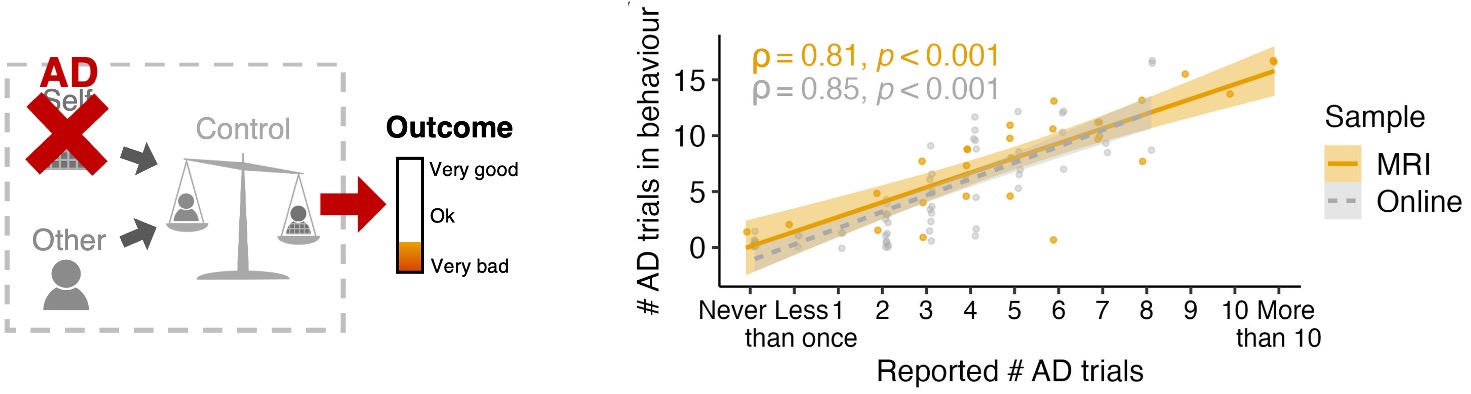
Why would deliberate mistakes help? By temporarily removing their own contribution, people could compare outcomes with vs. without their input - revealing whether results were driven by them or someone else. It is an efficient way to uncover one’s own control in social settings.
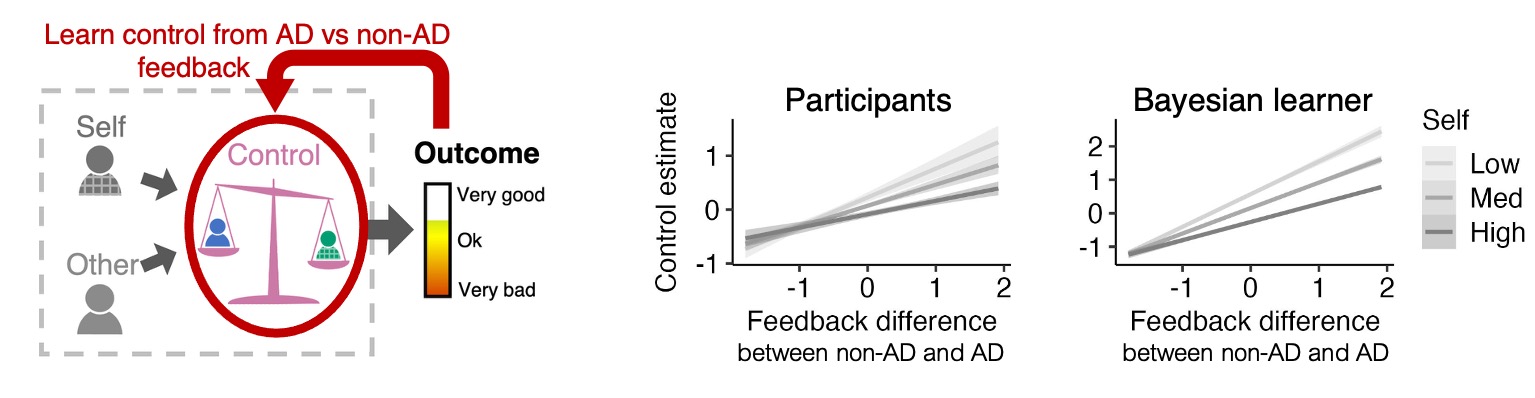
We formalised this intuition using computational models. Only a Bayesian learner that recognised AD as an informative intervention could explain human behaviour. Models that ignored AD — or misinterpret it — failed to infer controllability correctly.
Our fMRI results show that the supramarginal gyrus plays a crucial role in establishing controllability during social interactions. It tracks not just active disambiguation, but also inferred controllability and the components necessary for this inference.
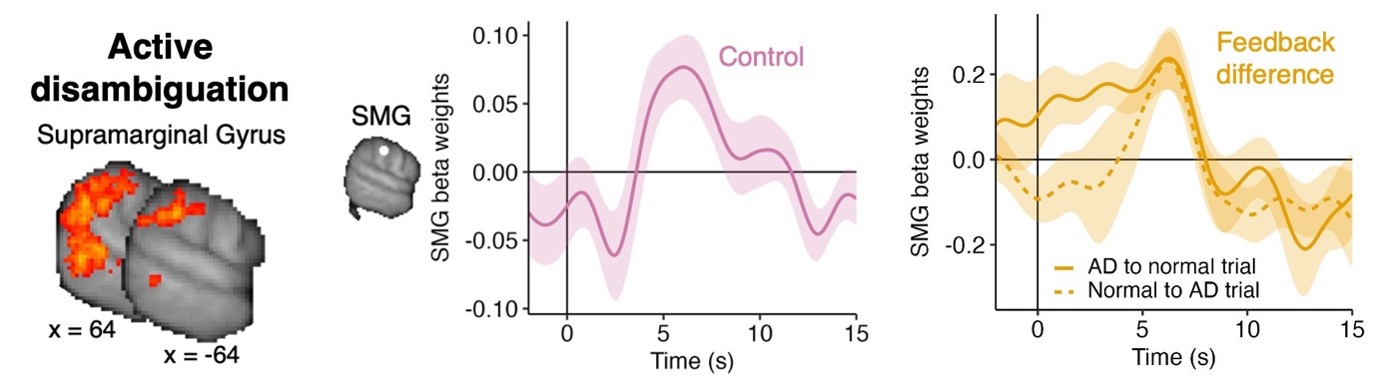
Activity in this brain region also signals a second learning mechanism, by which individuals attribute prediction errors to themselves versus others, in proportion to their perceived control.
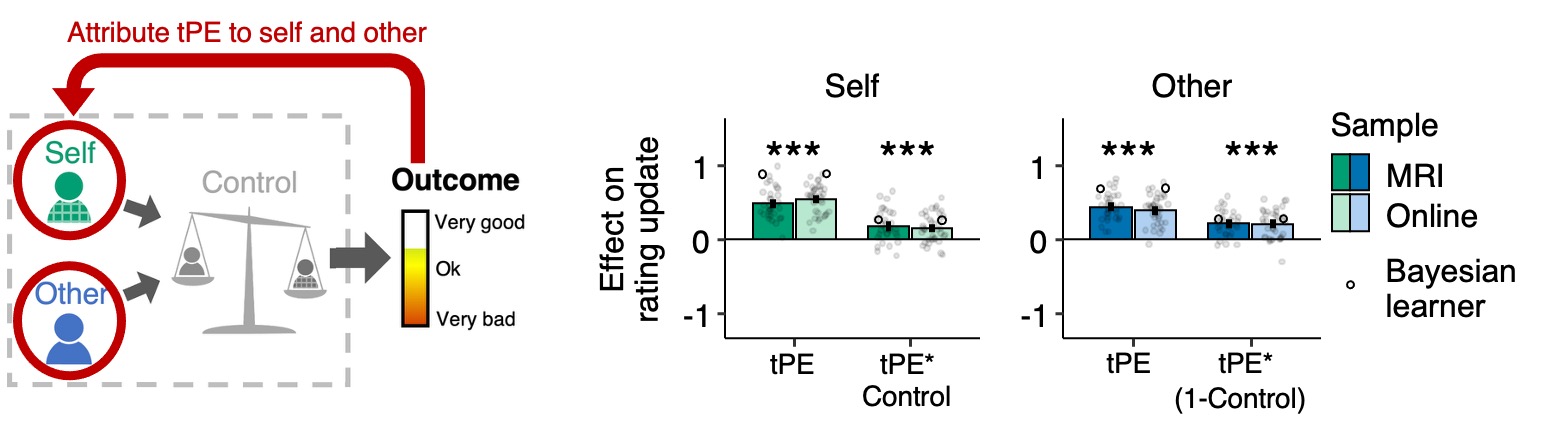
These findings provide a mechanistic account of how people infer control in social contexts and may also be relevant for understanding psychiatric conditions in which perceived control is distorted, including depression, psychosis, and schizophrenia.
(Micro)saccade-related potentials during face recognition: A study combining EEG, eye-tracking, and deconvolution modeling
Spiering & Dimigen, Attention, Perception, & Psychophysics, 2024
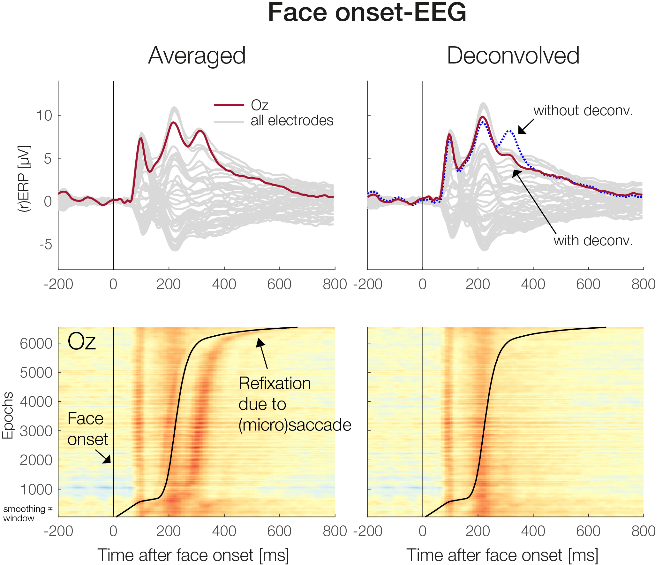
In this project, we combined EEG, eye-tracking, and deconvolution modelling to investigate brain responses during face recognition under more natural viewing conditions. We show that overlapping neural activity linked to rapid eye movements can be separated to reveal cleaner estimates of face-processing signals.
This is work I did for my undergraduate thesis and as a research assistant at Humboldt-University Berlin (Germany).
Paper · Code & data · Preprint
Read a longer summary
We examined how our brains process emotional faces, using computational models to analyse brain signals following eye movements. While many lab studies require people to look at pictures of faces without moving their eyes, we studied what happens in more natural situations when people freely decide which information to sample, that is which part of a face to look at. We show that our brains quickly pick up on emotions when we first see a face, but this emotional information is not necessarily represented after. This research helps us better understand how we perceive emotions in everyday situations.
Methodologically, this work demonstrates how EEG and eye-tracking data can be combined and brain responses (and artefacts) linked to eye movements can be unmixed using a novel computational technique called deconvolution modelling (unfold toolbox, Ehinger & Dimigen, 2019). This approach helps support more naturalistic lab-based experiments to gain a better understanding of how the brain processes its environment in real life.